

+91 96891 00451
connect@vikramdeshmukh.com
connect@vikramdeshmukh.com
By #Team_VikramDeshmukh&Consultants
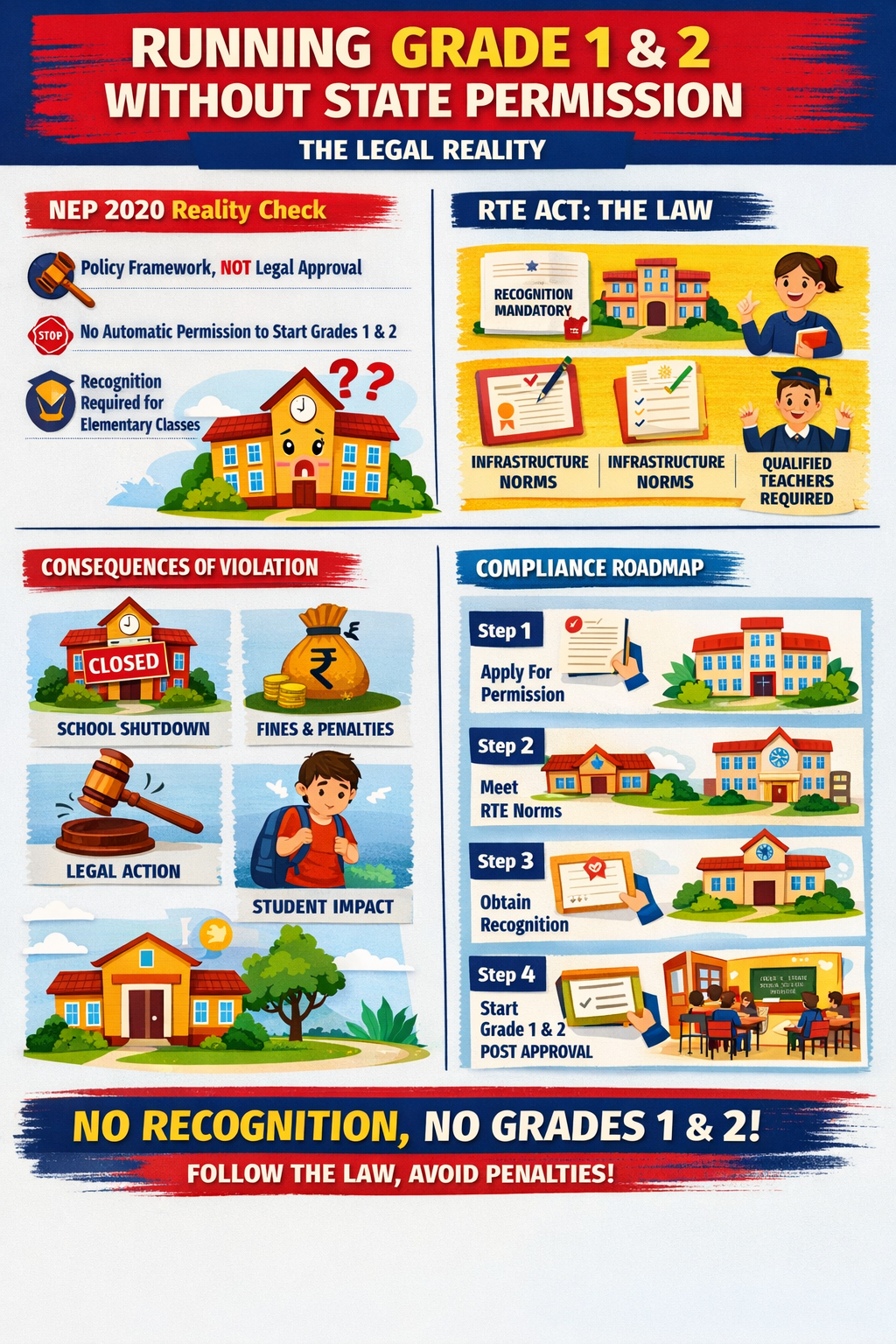
Since the introduction of National Education Policy 2020 (NEP 2020), there has been a noticeable shift in how early childhood education is conceptualized in India. While the policy has commendably integrated the foundational years (ages 3–8) into a single pedagogical continuum termed the Foundational Stage, it has also, unfortunately, led to widespread misinterpretation among preschool operators.
A growing number of preschool institutions are now assuming that NEP 2020 permits them to introduce Grade 1 and Grade 2 within their existing preschool framework—without obtaining formal recognition or permission from the State Education Department. This assumption is legally flawed and operationally risky.
This article clarifies the legal position and outlines the consequences of such non-compliance.
Understanding What NEP 2020 Actually Provides
NEP 2020 introduces a new curricular structure:
This restructuring is pedagogical, not regulatory.
Critical Clarification
NEP 2020:
It is a policy framework, not a statutory instrument.
Legal Position Under the RTE Framework
The Right of Children to Free and Compulsory Education Act 2009 (RTE Act) continues to remain the governing legislation for elementary education.
Key Legal Requirements
Under the RTE Act and respective State RTE Rules:
The Core Misconception
What Preschool Operators Are Assuming
Why This is Incorrect
Legal Consequences of Non-Compliance
Operating Grades 1 & 2 without recognition is not a minor procedural lapse—it is a statutory violation.
Consequences Under RTE Act
Regulatory View: Zero Tolerance Zone
State Education Departments across India are increasingly:
The regulatory stance is clear:
Pedagogical flexibility cannot override statutory compliance.
Distinction: Preschool vs Elementary School
|
Aspect |
Preschool (Nursery–UKG) |
Elementary School (Grade 1–8) |
|
Regulatory Body |
Local authority / Women & Child Dept. |
State Education Department |
|
Legal Framework |
State-specific preschool norms |
RTE Act + State RTE Rules |
|
Recognition Required |
Limited / varied |
Mandatory |
|
Teacher Qualification |
ECCE-based |
D.Ed./B.Ed. +TET/CTET Mandatory |
What Schools Must Do (Compliance Roadmap)
For preschool operators intending to expand:
Step 1: Apply for School Permission
Step 2: Infrastructure Compliance
Step 3: Staffing Compliance
Step 4: Obtain Recognition
Step 5: Gradual Expansion
Strategic Advisory for School Owners
Conclusion
NEP 2020 is a progressive and visionary reform—but it is not a license to bypass the law.
The integration of preschool and early primary years is academic in nature, while the authority to operate Grade 1 & 2 remains firmly within the legal framework of the RTE Act and State Rules.
Operating without recognition exposes institutions to:
For sustainable and compliant growth, regulatory alignment is not optional—it is foundational.
#NEP2020 #SchoolCompliance #RTEAct #EducationLaw #SchoolLeadership #Edupreneurs #SchoolManagement #K12Education #IndiaEducation #LegalAwareness #PhloxEducon #VikramDeshmukh
© Copyright - 2026. All Rights Reserved - Vikram Deshmukh Consultants