

+91 96891 00451
connect@vikramdeshmukh.com
connect@vikramdeshmukh.com
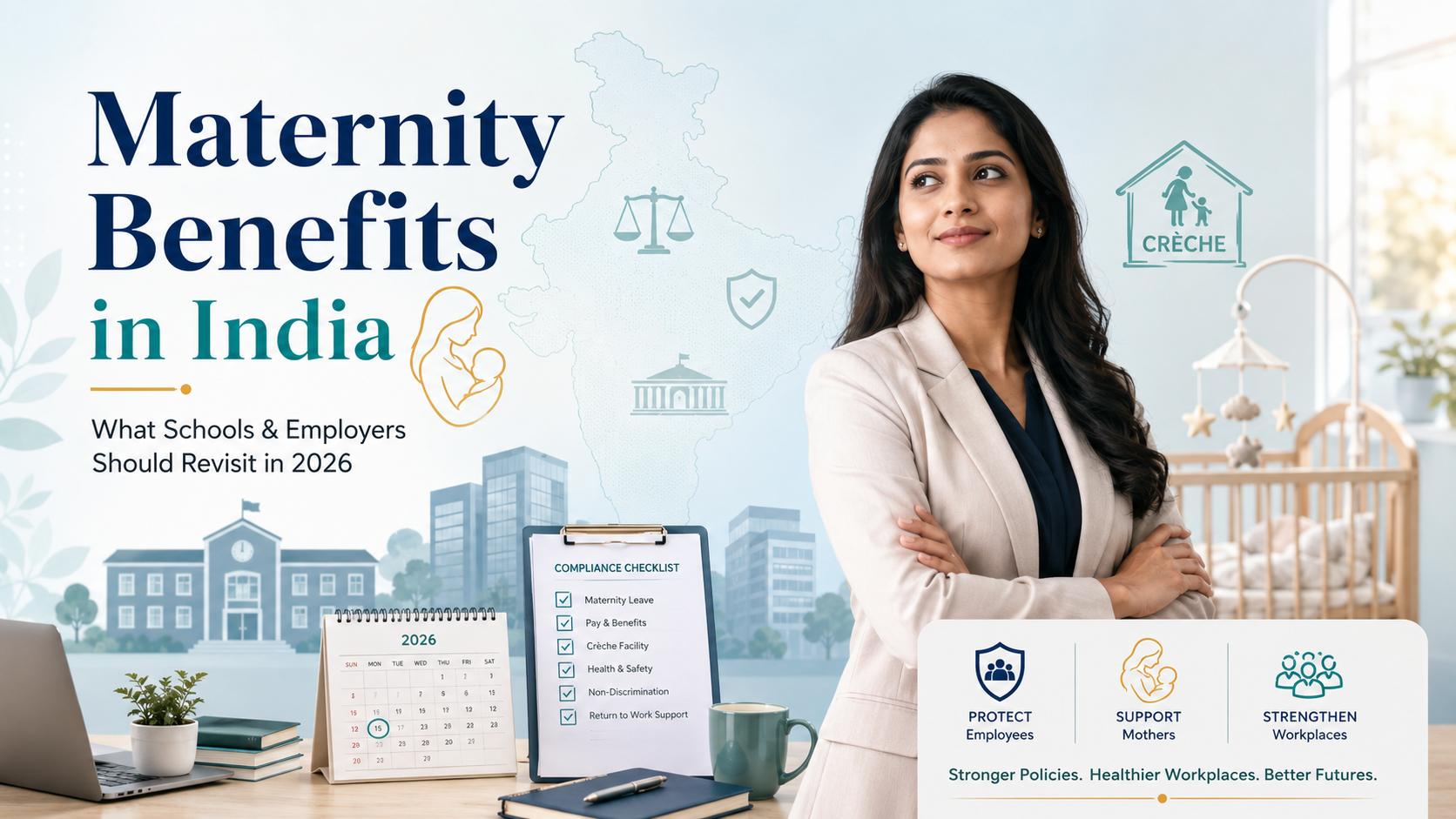
For many employers, the words “maternity benefit” still immediately bring to mind the Maternity Benefit Act, 1961.
That is understandable. For decades, the 1961 Act formed the backbone of maternity protection in India.
But the legal framework has now changed.
With the Code on Social Security, 2020 becoming effective from 21 November 2025, the Maternity Benefit Act, 1961 has been subsumed into the new Social Security Code. This was followed by the notification of the final Social Security (Central) Rules, 2026 on 8 May 2026.
For schools and other employers, therefore, maternity compliance in 2026 should no longer be approached simply by referring to an old HR policy stating:
“Maternity leave shall be governed by the Maternity Benefit Act, 1961.”
The policy, documentation and actual HR practices now need to be examined against the Code on Social Security, 2020, the applicable 2026 Rules and subsequent judicial developments.
For establishments covered by Chapter VI of the Code, a woman who has worked for the employer for at least 80 days during the twelve months immediately preceding the expected date of delivery is ordinarily eligible for maternity benefit.
Where she has fewer than two surviving children, the maximum maternity-benefit period is:
of which not more than 8 weeks may precede the expected date of delivery.
Where she already has two or more surviving children, the entitlement is:
with a maximum of 6 weeks preceding the expected delivery.
This is a paid statutory benefit, not merely permission to remain absent from duty.
The Code also separately provides protection in cases of:
miscarriage or medical termination of pregnancy — 6 weeks' paid leave;
tubectomy operation — 2 weeks' paid leave; and
illness arising out of pregnancy, delivery, premature birth, miscarriage or medical termination of pregnancy — up to one additional month of paid leave.
One of the most important developments of 2026 came from the Supreme Court.
Section 60(4) of the Social Security Code originally provided 12 weeks of maternity benefit to a woman who legally adopted a child below three months of age.
On 17 March 2026, in Hamsaanandini Nanduri v. Union of India, the Supreme Court held that this three-month age restriction violated Articles 14 and 21 of the Constitution.
The Court directed that Section 60(4) should now effectively be read to mean that:
The same 12-week entitlement continues for a commissioning mother.
The judgment is significant beyond the immediate statutory issue. The Court emphasised that maternity protection is concerned not merely with biological childbirth but also with motherhood, caregiving, bonding and the integration of a child into the family.
The Court also urged the Union Government to consider recognising paternity leave as a social-security benefit. Importantly, however, this observation should not be misunderstood as having itself created a general statutory paternity-leave entitlement for employees in the private sector.
The Code provides that after returning to work following delivery, a woman is entitled to two nursing breaks during every working day, in addition to normal rest intervals, until the child attains 15 months of age.
The final Rules notified on 8 May 2026 now prescribe that:
Where the child is kept in a crèche or another childcare location, reasonable additional travel time is also contemplated, up to the limit prescribed by the Rules.
This is particularly relevant to schools, where teaching timetables are often structured period-by-period. The entitlement cannot be ignored merely because accommodating it requires timetable planning.
Where 50 or more employees are ordinarily employed, the crèche provisions become relevant.
The threshold is 50 employees — not 50 female employees.
The 2026 Rules prescribe considerably greater detail regarding the facility. Among other requirements, the crèche is intended for children below six years and should ordinarily be located within one kilometre of the establishment. The Rules prescribe minimum accommodation, sanitation, staffing, feeding, first-aid and related standards.
The Rules also introduce an interesting agreement-linked crèche allowance mechanism, prescribing an amount of not less than ₹500 per month per child in specified circumstances where the required facility is not provided.
However, employers should exercise caution here.
This should not be interpreted to mean that an employer can simply decide to pay ₹500 and dispense with its crèche obligation. The allowance operates within the specific agreement framework prescribed in Rule 37.
The Code recognises that, where the nature of the work assigned to a woman permits, the employer may allow her to work from home after the maternity-benefit period.
But the duration and conditions are to be mutually agreed between the employer and employee.
This distinction matters.
“Work from home” after maternity leave is therefore not an unconditional statutory entitlement in every employment situation.
For schools, its feasibility may understandably differ between a classroom teacher and an employee performing curriculum development, academic planning, administration or another role capable of remote performance.
One of the common mistakes in maternity compliance is to treat the issue only as a question of:
How many weeks of leave does the employee get?
The statutory framework is much broader.
It includes protection against dismissal or disadvantageous alteration of service conditions because a woman has exercised her maternity rights.
It includes prescribed protection from arduous work during specified stages of pregnancy.
It includes nursing breaks, crèche access and medical bonus requirements in appropriate cases.
And importantly, Section 67 requires establishments covered by Chapter VI to inform every woman in writing and electronically, at the time of initial appointment, about the benefits available under the maternity-benefit chapter.
That last requirement alone means that many organisations may need to reconsider their appointment letters, joining kits and HR onboarding processes, and not merely their maternity-leave policy.
This requires particular care.
The HR team should not stop its analysis merely after determining that an employee is registered under ESI.
Section 61 of the Social Security Code provides continuity of the Chapter VI maternity entitlement until the woman actually becomes qualified to claim maternity benefit under the ESI mechanism.
In practical terms, therefore, the correct question is not simply:
“Is she an ESIC employee?”
It is:
That distinction can materially affect who is responsible for providing the benefit.
For school managements and HR teams, 2026 is an appropriate time to review the entire maternity-compliance architecture rather than merely updating the heading of an old policy.
At a minimum, institutions should examine:
their maternity-leave policy;
appointment letters and HR handbooks;
eligibility and salary-computation procedures;
ESIC versus employer-paid maternity-benefit determination;
maternity application and medical-documentation formats;
nursing-break implementation;
employee-strength calculation for crèche applicability;
crèche/common-crèche arrangements;
work-from-home provisions;
safeguards against adverse employment action during maternity absence; and
any existing contractual benefit that may be more favourable than the statutory minimum.
For private schools in Maharashtra, there is an additional layer to consider. As on September 2026, the Maharashtra Labour Department continues to identify the State's Code on Social Security Rules, 2026 as draft rules, whereas the Central Rules have been finally notified.
Accordingly, compliance needs to distinguish carefully between the operative provisions of the Code, matters prescribed centrally, and State-specific procedural requirements rather than treating every draft State provision as already enforceable law.
The important change is not that maternity protection has suddenly become a new concept.
It is that the statutory architecture governing an established employee right has changed.
Policies drafted five or ten years ago may still contain broadly familiar benefits, but they may now refer to a repealed statute, omit the procedural requirements of the 2026 Rules, overlook the ESI transition mechanism, or — particularly after the Supreme Court's March 2026 judgment — state an incorrect position concerning adoptive mothers.
For educational institutions, good governance requires more than responding correctly when a maternity application arrives.
This article is intended for general legal and compliance awareness and should not be treated as an establishment-specific legal opinion.- Vikram Deshmukh, Edu-Legal Strategist.
#EduLegal #SchoolGovernance #MaternityBenefits #SocialSecurityCode #HRCompliance #EducationLaw #SchoolManagement #LabourLaw #WomenAtWork #Compliance
© Copyright - 2026. All Rights Reserved - Vikram Deshmukh Consultants